n8n is the main Zapier alternative when cost is the reason: it bills one execution per workflow run, from EUR 20 a month for 2,500, where Zapier bills each action step. Make is the visual pick with cheaper per-action credits.
The usual reason to leave Zapier is the bill, and the bill comes from how Zapier counts work. Zapier charges per task, roughly one per action step that succeeds, so a ten-step Zap that runs 1,000 times uses about 10,000 tasks. n8n charges per workflow run regardless of steps, and Make charges per module action at a lower unit price. Those two are where most people end up. Workato and Tray.ai replace Zapier when IT wants governance, and Cargo is the pick if the zaps are all GTM data plumbing.
How Zapier's pricing pushes people out
On the November 2026 pricing page, Professional was $19.99 a month billed annually or $29.99 monthly at 750 tasks, and Team was $69 annually or $103.50 monthly at 2,000 tasks. Both scale up by task tier. The Free plan gives 100 tasks a month and two-step Zaps only.
A few details matter more than the headline:
- Steps are the meter. Triggers, polling, Formatter, Filter, Paths, Delay and Tables don't count. Successful action steps, AI by Zapier and Code steps do, and AI or long-running Code steps can cost more than one task. A Zapier MCP tool call counts as two.
- Overage is pricier on monthly billing. With pay-per-task on, extra tasks bill at 1.25 times the base rate on annual plans and 2.5 times on monthly ones.
- Allowances reset monthly, even on annual plans, so a quiet month doesn't bank tasks for a busy one.
None of this makes Zapier a bad buy. Its app directory is the largest, and a sales ops person can build a working Zap in ten minutes. It gets expensive when a few long workflows run thousands of times a month, which is what GTM automations (enrich, score, route, write back to the CRM) tend to be.
What each alternative charges for
| Tool | You pay per | Starting paid plan (Nov 2026) | Best when |
|---|---|---|---|
| Zapier | Successful action step | $19.99/mo annual, 750 tasks | Non-technical builders, long app tail |
| n8n | Whole workflow run | EUR 20/mo annual, 2,500 executions | Long workflows, or you'll self-host |
| Make | Module action (credit) | See pricing | Visual builders who want branching cheap |
| Workato | Tasks by capability, quoted | Quote | IT-owned, governed automation |
| Tray.ai | Tasks plus compute units | From $50/mo (Helix Builder) | Integration-heavy teams that want an API platform |
| Cargo | Credits (100 workflow steps each) | From $165/mo, 1,500 credits | GTM data, enrichment and routing flows |
n8n
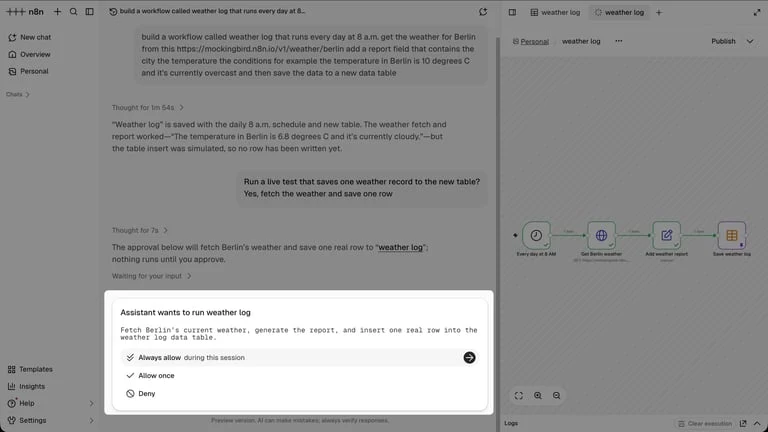
n8n counts one execution per workflow run, "regardless of how many steps it has", so the long workflows that cost the most on Zapier cost the same as short ones. Cloud Starter was EUR 20 a month billed annually for 2,500 executions and Pro EUR 50 for 10,000 on the November 2026 page. The Community edition can be self-hosted from GitHub with no license fee, and Business (EUR 667 a month, annual) is a self-hosted license with SSO and queue mode.
The catch is that n8n expects a more technical builder. It has code steps, branching and error workflows, and you'll use them. Self-hosting also moves the uptime problem to you: when we ran our own scheduled GTM jobs as scripts, a reply watcher on a laptop cron stopped after five days, and nobody saw the errors it logged. n8n cloud vs self-hosted covers that choice, and n8n vs Zapier goes step by step. Plans are in our n8n pricing record.
Make
 Make
Count branches and actions across a complete scenario.
Make (formerly Integromat) is the visual alternative. Scenarios are drawn as a flowchart, with routers, iterators and aggregators that Zapier handles less gracefully. Since its switch to credits, most module actions use one credit, and routers and error handlers use none. The Free plan includes 1,000 credits a month. Paid plans (Core, Pro, Teams) sell credit tiers, with extra credits in packs of 1,000 or 10,000; we couldn't read plan prices from the pricing page in November 2026, so check Make's pricing for your tier.
The trade is that credits still scale with steps, so a scenario that iterates over 500 rows uses credits for each pass. Make wins on per-unit price and on complex branching, and n8n wins when a run has many steps. See Make vs Zapier and Make alternatives.
Workato
 WorkatoPublished capabilities
- Application integration
- Workflow orchestration
- Data movement
Which features and usage are included in your exact plan?
Check product scope ↗Workato is the enterprise replacement, chosen when automation moves from a sales ops person's account to IT. It meters by capability (workflows, API management, event streams) with unlimited workspaces and users, and it doesn't publish prices; every edition is quoted. Editions differ in concurrency, log retention and how many on-premise agents you get. It's the right move when you need audit, environments and access control over hundreds of recipes. For a small team trying to cut a Zapier bill, it's the wrong direction. See Workato alternatives.
Tray.ai
- Application and API integration
- Workflow automation
- Agent building
Which features and usage are included in your exact plan?
Check product scope ↗Tray.ai sits between Zapier and Workato. It meters Tasks (each trigger, connector step and loop pass counts one, retries are free) plus Helix compute units for hosted work. The only published number is a $50 a month starting price for its Helix Builder edition; Pro, Team and Enterprise are sized by quote. The 30-day trial includes 1 million tasks with no card, which is enough to rebuild your three busiest Zaps and see the real count. Workato vs Tray.ai compares the two enterprise options.
Cargo
 CargoPublished capabilities
- Repository-owned TypeScript workflows
- Production execution
- Retries
Which runtime limits, retries and provider costs are included?
Check product scope ↗Cargo is narrower: a GTM workspace for enrichment, scoring, routing and CRM sync. It replaces Zapier for teams whose zaps are mostly "new lead, enrich it, score it, send it to the right rep". Credits pay for enrichment provider calls, AI tokens, storage and orchestration, at 100 workflow steps per credit. Paid plans start at $165 a month for 1,500 credits (November 2026, monthly figure on the page). It won't replace the Zap that posts to Slack when an invoice is paid. Many teams keep a small Zapier plan for those and move the data work.
Moving off Zapier
There's no export that another tool imports. Each Zap is rebuilt by hand, so start with a list:
- Open Zap history, sort by task usage, and move the top five first. They're usually most of the bill.
- Note every webhook URL that other systems call. Each changes when you rebuild, and the sender has to be updated.
- List the apps that only Zapier connects to. If a niche app has no native module in the new tool, you'll need an HTTP step and its API docs.
- Run old and new side by side for a week with the new one writing to a test field, then cut over.
- Check Zapier Tables and Interfaces. Data stored there has to be exported separately.
For the broader category, see workflow automation tools.
Questions buyers ask
What is cheaper than Zapier?
n8n for long workflows, since it bills per run: EUR 20 a month on annual billing for 2,500 executions in November 2026. Self-hosted n8n Community has no license fee. Make is usually cheaper per action.
Is there a free alternative to Zapier?
Self-hosted n8n Community edition is free software; you pay for the server. Make's Free plan includes 1,000 credits a month, against Zapier Free's 100 tasks and two-step limit.
Zapier vs Make: which is better?
Zapier is quicker to build and connects to more apps. Make is cheaper per action and better at branching and loops.
Zapier vs n8n: which costs less?
n8n, once workflows have more than a few steps. Zapier counts each successful action step as a task; n8n counts one execution per run.
Can I import my Zaps into another tool?
No tool imports Zaps directly. Rebuild them by hand, starting with the Zaps that use the most tasks.