Which one fits your team?

Choose Clay
When you need to orchestrate providers, research steps and custom enrichment logic.

Choose Apollo
When you want a prospect database with an integrated outreach workflow.
Clay can use external providers; it is not itself a like-for-like replacement for Apollo’s entire sales workspace.
The differences that matter
| Decision | Clay | Apollo |
|---|---|---|
| Primary scope | Enrichment orchestration | Sales database and engagement |
| Shortlist when | You need to orchestrate providers, research steps and custom enrichment logic. | You want a prospect database with an integrated outreach workflow. |
| Buying model | Launch (headline, entry tier): $185/month · monthly billing | Basic: $65/month · monthly billing |
| Confirm before purchase | Which steps use Clay credits, and which bill your own provider account? | Are API enrichment, phone numbers and email exports covered by the plan you are considering? |
Clay: where it fits
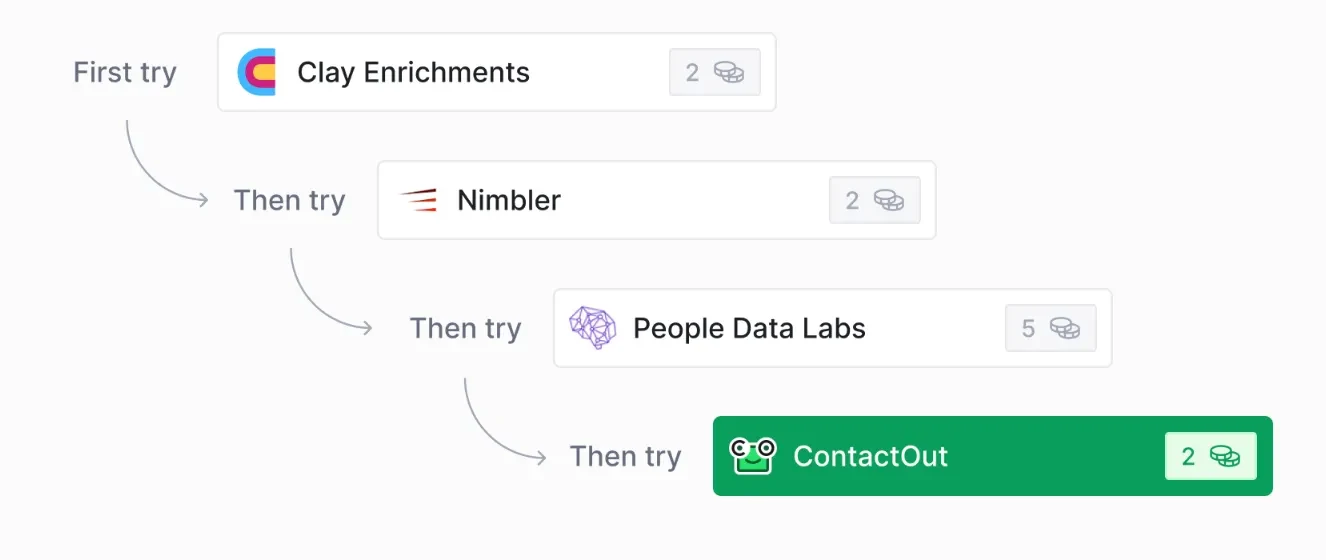
Clay is an orchestration and data workspace for GTM teams. It combines access to data providers with research and workflow execution. The central operating decision is how a record moves through the table or workflow: which provider runs, what happens on a miss and what is written to the destination system.
Capabilities to compare:
- Data-provider marketplace
- Enrichment workflows
- AI-assisted research
- Visual GTM workflow building
- Bring-your-own provider keys
Tradeoff: Clay actions and data credits are separate cost drivers. Bringing a provider key can move the data charge to that supplier while retaining Clay action consumption. A full record can invoke multiple steps, so calculate costs from the actual workflow.
In an evaluation: Build a small enrichment flow with a known input list, an acceptance rule and a fallback provider. Record the action count, data credits and external charges, then test a timeout and a replay before increasing volume.
We priced Clay in July 2026 and didn't trial it. Our job was a weekly feed of job changes on 8,000 people and news on about 400 accounts a month, pushed into the CRM, and at Clay's published unit costs that came to about $610 a month. The webhook and CRM integrations it needed sat on Growth, so Launch was out. We already had Apollo for the people data, which made Clay's question for us a narrow one: was the orchestration worth that much on top? The model is on Clay pricing.
The pricing record separates billing periods, allowances and source dates. Use that configuration in the cost comparison rather than combining a monthly seat price with a different product’s annual rate.
Apollo: where it fits
Apollo is worth it for its free people search and its company enrichment; reveals need your own checks. In our 2026 API runs the free search found an emailable buyer at about 7 in 10 of some 3,500 target domains for 0 credits, with surnames masked until you pay. Three search filters returned HTTP 200 and were ignored, so compare totals before you trust a result.
ApolloSearch finds people; enrichment reveals contact data.
Per seat. 30,000 credits/seat/yr annual (2,500/mo on monthly view)
Read the product profile and source details.
We ran Apollo's API from February to September 2026 and built our own waterfall around it, with Apollo's free people search as the first stage and ZeroBounce at the end. That is the kind of flow Clay would otherwise run for you. Two gaps showed up that Clay or your own code would have to cover: the API has no lookalike company search, and no endpoint returns your credit balance, so we kept a ledger by hand. The stage-by-stage yields are on waterfall enrichment, and the per-endpoint billing on Apollo API credits.
Questions buyers ask
A useful evaluation
Clay can use external providers; it is not itself a like-for-like replacement for Apollo’s entire sales workspace.
Use the same inputs and record the purchased edition, charges, output statuses and manual work. Save the export and a failed-run example so the future owner can inspect the result.