Waterfall enrichment queries data sources one after another and stops when a contact meets your acceptance rule. FullEnrich and BetterContact run a managed waterfall billed on finds; Clay and Databar let you build your own.
Your shortlist
Editorial selectionThese products cover different parts of this job. Use the fit and buying model to decide which belong in your evaluation; display order is not a performance ranking.

GTM engineers combining data providers, research and enrichment in one workflow.
Launch (headline, entry tier): $185/month · monthly billing
Vendor source ↗Pricing read 2026-11-09 · USDTeams wanting one enrichment supplier to query multiple underlying providers.
Pro (1,000 credits/mo tier): $55/month · monthly billing
Vendor source ↗Pricing read 2026-11-09 · USDOperators who want a managed multi-provider enrichment sequence.
Read profile →Teams evaluating a workspace, API and MCP access to multiple data providers.
Read profile →Persana focuses on prospect discovery, enrichment and personalized outbound. Its website describes ICP building and signals such as funding, hiring and website visits. It should be evaluated as a data-and-activation workflow, with attention to how the current product and commercial package relate to the wider Rox offering mentioned in earlier research.
Read profile →Engineers building their own enrichment pipeline around specific email, phone and company lookups.
Read profile →Teams comparing web-app enrichment and API access to email, mobile and company data.
Read profile →
Teams comparing a specialist email validation service for bulk lists or an API workflow.
Read profile →Track past champions as they change jobs, and pull lookalike companies you will grade yourself.
Growth: from $250/month · confirm commitment
Vendor source ↗Pricing read 2026-11-12 · Currency not specifiedBuying notes
- Send each stage only the rows earlier stages left empty, and measure it on those rows.
- Put stages that charge nothing on a miss first and the per-check verifier last.
- Stop on a hit, on a catch-all domain, and when the balance can't cover the batch.
- Log errors apart from empty results; quota errors recorded as misses hid a failed run.
- Define accepted before you count: valid, own domain, buyer role, fit company.
Waterfall enrichment sends a contact to one data source, and passes the rows it can't fill to the next source, until a row meets the standard you set or the list of sources runs out. Managed services such as FullEnrich and BetterContact run the sequence for you and bill only on finds. Clay and Databar let you build the sequence yourself. A pipeline built from individual APIs gives you the most control and the most to maintain.
| You want | Start with |
|---|---|
| Emails and mobiles from a CSV, billed on finds | FullEnrich or BetterContact |
| Your own stage order, research steps and CRM writes | Clay or Databar |
| A cheap first stage that charges nothing on a miss | QuickEnrich or LeadMagic |
| A check on whatever the waterfall returns | ZeroBounce or another email verifier |
How does waterfall enrichment work?
Each stage gets only the rows the stages before it left empty. A stage that charges nothing on a miss goes first; a stage that charges per check, such as a verifier, goes last and only sees addresses worth checking. The sequence stops on a row once it meets your acceptance rule, so you don't pay twice for a contact you already have.
Measure each stage on the rows it received. In our run the web-search stage filled 88% of the rows that reached it. Counted against the full list it would have looked like 82%, which undersells it, since the rows the website stage had already filled never reached it.
The waterfall we ran
In September 2026 we built a buyer list for about 500 target companies without spending a contact-data credit. The output went to ad audience matching, so catch-all and unknown addresses stayed in; a cold email list would keep only the valid ones.
| Stage | Rows in | Rows filled | Cost |
|---|---|---|---|
| Apollo free people search on about 500 domains | about 500 domains | about 2,300 buyers at about 290 companies, surnames masked | 0 credits |
| Surname from the company website | about 2,300 | about 170 (7.4%) | crawl time |
| Web search on first name, title and domain | about 2,100 | about 1,900 (88%) | about $0.001 a query |
| ZeroBounce format probe | about 280 companies | verified format at about 80% of them | about 820 credits |
| Build and verify addresses | built addresses | 752 of 900 checked came back valid | about 1 credit each |
| Output | about 1,550 addresses at about 240 companies: about 93% valid, 5% unknown, 2% catch-all | about 1,700 ZeroBounce credits, 0 Apollo credits |
Apollo's free search returns a first name, an exact title and a masked surname, which is enough to know a buyer exists. The web search recovered most surnames. Probing each company's address format took 2.9 credits on average, and 148 of the 900 pattern-built addresses we checked one by one failed. A pattern is a guess until a verifier says otherwise. The Apollo API notes cover which of its endpoints cost credits.
When should a waterfall stop?
Four stop rules kept our runs cheap:
- Stop on a hit. Once a row has an address the verifier accepts, it leaves the sequence.
- Stop on a catch-all domain. We sent six guesses plus one made-up address to a domain; when the server accepted the made-up one, no guess on that domain could be trusted, so we moved on.
- Stop when the balance can't cover the batch. Apollo has no credit balance endpoint, so we checked usage ourselves before each batch.
- Keep errors apart from empty results. In one run, quota errors on 103 of 105 seed companies were first recorded as "no contacts found". A waterfall that treats an error as a miss sends the row on to a paid stage and hides the failure.
The enrichment API checklist has the other silent failures we hit, including filters that were ignored while the API still returned HTTP 200.
What does a verified contact cost?
Decide what "accepted" means before you count. We used four gates: ZeroBounce returns valid; the address sits on the company's own domain; the person holds a buyer role; and the company fits and isn't already a customer or an open deal. Apollo marked a wrong-company address as verified in 2 of 22 reveals we checked by hand, so the domain gate earns its place.
Counting that way, the run above cost about 1.1 ZeroBounce credits per address we kept for ad matching and about 1.2 per valid address. At ZeroBounce's smallest pack in November 2026 ($39 for 2,000 credits), the credits plus about 2,100 web searches came to about $36, or about 2.5 cents per valid address. The Apollo search cost nothing beyond a plan we already paid for.
Spend that bought nothing came from four places:
- Apollo's bulk match billed a credit per match even with the email and phone reveal flags off.
- Guesses on catch-all domains used verifier credits without settling anything.
- Old verdicts went stale. Valid addresses failed at about 1.35% a month in our re-check, so a list verified in spring needs checking again.
- Quota errors logged as empty results made later stages pay for rows an earlier stage could have filled.
QuickEnrich, and several Apollo calls, charged nothing on misses, which is why they belong early in the sequence. Keep a ledger per run: date, endpoint, credits before and after, rows in, statuses back, and the gate each rejected row failed. If you plan from signals, size the job from yield: we modelled about 40% of signals ending as a send-ready contact, so 2.5 signals per contact you want. The enrichment cost calculator does the arithmetic.
Managed waterfall, workspace or your own code?
A managed waterfall such as FullEnrich or BetterContact is the fastest route from a CSV to verified emails and phones, and you pay only for finds. You can't change the order of providers or see which one answered. A workspace such as Clay lets you set the order, add research steps and write back to the CRM, and you pay for actions as well as data. Your own code gives full control over stages, retries and logging, and the upkeep falls to you. The data enrichment guide counts build against buy for a weekly feed.
Clay
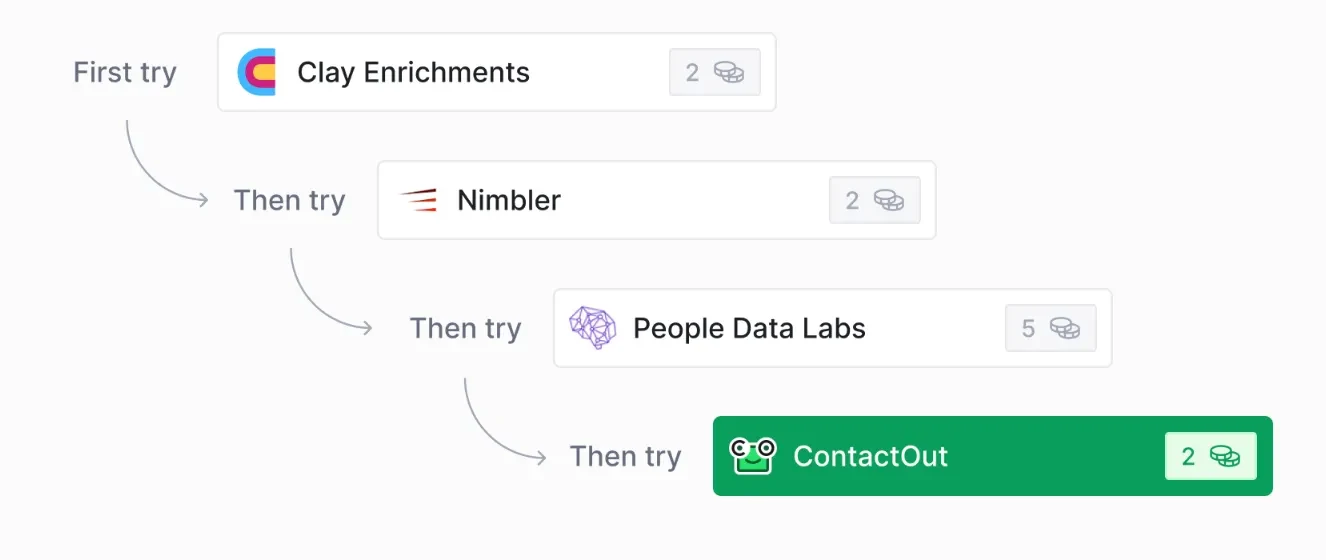
Clay is a spreadsheet-style workspace where each column can call a data provider, an AI research step or your own API key. It fits teams that want to set the stage order and write results to a CRM. When we priced a weekly feed in July 2026, the model came to tens of thousands of actions and nearly 10,000 data credits, roughly $500 to $700 a month on Growth, the plan that adds webhooks and CRM sync. Empty results cost nothing; a step on your own key costs an action but no data credit. Check how many actions a full row takes before you scale. Plans and dates are on the Clay pricing record, and Clay vs FullEnrich compares the two routes.
FullEnrich
Measure the additional accepted records from the waterfall.
FullEnrich runs a managed waterfall across 20+ contact-data vendors (its pricing table says 25+) from a CSV, a HubSpot list or its API. It fits teams that want emails and mobiles without building a sequence. It says it drops data that fails its verification and doesn't charge for it, checks emails with three engines and tries to resolve catch-all domains. API access and bulk CSV come with Pro, and rate limits are only listed for Enterprise, so ask for them before heavy API use. See the FullEnrich pricing record and FullEnrich vs BetterContact.
BetterContact
 BetterContactPublished capabilities
- Starter is mostly an email plan. The plan comparison leaves phone verification and catch-all verification off Starter, even though the plan is pitched at reps "starting on the phone."
- Catch-all handling differs by plan. Starter says catch-alls aren't charged, while catch-all *verification* is Pro and up. Ask what a Starter user gets back for a catch-all domain.
- Plan limits overlap. Pro tiers go up to 50,000 credits, but Enterprise is described as starting above 20,000. Pin down which plan your volume falls into before you sign.
Can you export the result status and charges for every row?
Check product scope ↗BetterContact queries 20+ providers for emails and mobile numbers and charges only for valid results. A routing model picks the provider order per contact from geography, industry and seniority; you can't see or change it. Emails are verified through Bouncer, mobiles through carrier and live-ping checks, and Enterprise accepts your own provider keys. It fits phone-heavy teams. The site describes its validator as 4-layer in one place and 5-layer in another, so ask which checks run on your plan. Pricing.
Databar
 DatabarPublished capabilities
- People and company discovery
- Multi-provider enrichment
- Research workflows
Which providers and output fields consume each type of credit?
Check product scope ↗Databar is a data workspace with API and MCP access to many providers, for finding, enriching and monitoring people and companies. It fits teams that want Clay-style building with an API-first setup. Keep the provider and date beside each returned field, and confirm which attempts use credits, including on rows nothing was found for. Pricing.
Persana
 PersanaPublished capabilities
- ICP-based prospect selection
- Enrichment
- Signal-based prioritization
Which features and usage are included in your exact plan?
Check product scope ↗Persana bundles prospect discovery, enrichment, signals such as funding and hiring, and AI-written outbound. It fits a team that wants one tool from list to first message. A bundle can hide what each data provider costs, so ask what event is billed at each stage and whether you can export the enriched rows. Pricing.
LeadMagic
 LeadMagicPublished capabilities
- Extra users cost $20/month each and share the plan's credits. Tables editors cost $49.99/month each.
- On monthly plans, unused credits roll over up to 2× the plan's monthly allowance. Annual credits refresh once a year.
- You can't reset a monthly plan early. If you run out, you can top up (5,000 to 200,000 credits, valid for 12 months), turn on auto top-up, or upgrade. Upgrading starts a new billing cycle that day.
Which endpoints charge for an unsuccessful lookup?
Check product scope ↗LeadMagic sells contact and company lookups from one credit balance through its app, REST API, a CLI and an MCP server. It publishes a rate card, and it says errors, not-found lookups, unknown validation results and rate-limit rejections use no credits. That makes it a good early stage: rows it can't fill cost nothing. Check whether its job-change detector bills per request when nothing changed. Pricing and LeadMagic vs Prospeo.
QuickEnrich
 QuickEnrich
Keep web-app use separate from API limits.
QuickEnrich finds contacts at a company for free and charges a credit for each record it reveals; misses cost nothing. In our October 2026 trial, ZeroBounce returned over 90% of 100 revealed emails as valid, and 73 of the 100 had a usable direct phone. We picked those 100 from people QuickEnrich had already flagged as having an email, so that measures reveal quality, not how often it finds one. Its gap is coverage: about 7 in 10 of some 8,000 good-fit companies we checked had no one in a target role, so test it on your own list before you put it first. The QuickEnrich pricing record has the October 2026 plans.
How to test a waterfall on your list
- Freeze one input list of a few hundred rows and write down your acceptance rule.
- Run the cheapest stage that charges nothing on misses, and send only its empties to the next stage.
- Log credits before and after each stage, and keep errors in their own column.
- Verify the output from outside the waterfall, with your own verifier.
- Divide total spend by contacts that passed your gates, and compare that figure across options.
Questions buyers ask
What is waterfall enrichment?
Waterfall enrichment sends each contact through a sequence of data sources and passes along only the rows the earlier sources couldn't fill. It stops on a row once the result meets your acceptance rule, such as a verifier marking the email valid.
What are the best waterfall enrichment tools?
FullEnrich and BetterContact are the managed options: upload a list and pay only for verified finds. Clay and Databar let you build your own sequence and write results to a CRM. LeadMagic and QuickEnrich work well as cheap early stages because misses cost nothing.
Is waterfall enrichment worth it?
Only if the later stages add accepted contacts at a price you'd pay. Run the second source on the first source's misses alone, remove duplicates, and divide the extra spend by the extra contacts that pass your gates.
Can you build a waterfall without paying for contact data?
For some lists, yes. Our September 2026 run used Apollo's free people search, the company website and web search to find about 1,550 addresses at about 240 companies for about $36 in verifier credits and searches. It needs code and a verifier, and it suited ad audience matching better than a cold email list.
Should I verify emails from a waterfall service?
Yes, for anything you'll email. Services verify with their own tools, and a finder's verified label describes how it got the address. A separate verifier catches wrong-company domains and addresses that have gone stale since the service checked them.