Which one fits your team?

Choose n8n
When code steps, technical control or self-hosting matter.

Choose Make
When a managed visual scenario is the preferred operating model.
Compare complete-run billing, error recovery and the time needed to maintain the flow.
The differences that matter
| Decision | n8n | Make |
|---|---|---|
| Primary scope | Workflow automation | Visual workflow automation |
| Shortlist when | Code steps, technical control or self-hosting matter. | A managed visual scenario is the preferred operating model. |
| Buying model | Starter: €20/month · annual commitment | Custom pricing; quote on request |
| Confirm before purchase | Are you paying for cloud executions, an enterprise edition, or your own hosting and operations? | How many billable credits does a successful record consume, including retries? |
n8n: where it fits
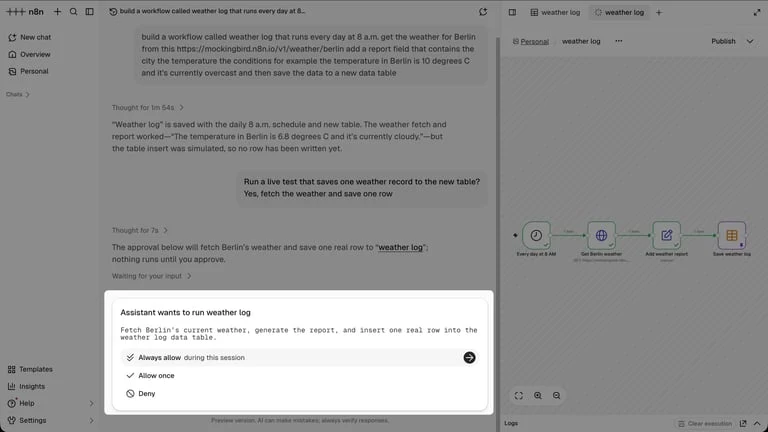
n8n is a workflow platform that combines a visual execution graph with code-capable steps. It can be used as a hosted service or operated on your own infrastructure. GTM use cases include incoming lead validation, enrichment, routing and CRM updates, with the workflow owner responsible for the behavior between connected systems.
Capabilities to compare:
- Visual workflow editor
- Code steps
- API and application connections
- AI-agent workflows
- Cloud and self-hosted editions
Tradeoff: Cloud execution billing and self-hosted operating cost require different budgets. The Community edition does not include every paid-edition feature, and self-hosting still requires backups, upgrades and monitoring. Check the license and edition for the intended use.
In an evaluation: Build a lead-intake flow with validation, a durable deduplication check and a CRM write. Deliberately fail the external API step, inspect the run and recover it without creating a duplicate record or paying twice for a completed lookup.
The pricing record separates billing periods, allowances and source dates. Use that configuration in the cost comparison rather than combining a monthly seat price with a different product’s annual rate.
Make: where it fits
MakeCount branches and actions across a complete scenario.
Make uses a visual scenario builder to connect applications and automate work. Its current product site includes AI agents, custom code, observability and MCP-related capabilities. For a GTM operator, the important question is whether the person maintaining a scenario can follow each record through branches, external calls and error handling.
Capabilities to compare:
- Visual workflow builder
- Application connections
- Branching scenarios
- Custom code
- Automation observability and AI workflows
Tradeoff: Credits consumed across modules and branches need to be calculated for a complete record. A nominal task on another platform may not be the same billing unit. Consider how polling and retries affect both cost and maintenance.
In an evaluation: Model a real enrichment or routing scenario, record the steps on successful and failed paths, and have the future owner repair one error. Verify that an output is written exactly once and that a retry has a clear cost.
Questions buyers ask
A useful evaluation
Compare complete-run billing, error recovery and the time needed to maintain the flow.
Use the same inputs and record the purchased edition, charges, output statuses and manual work. Save the export and a failed-run example so the future owner can inspect the result.