Which one fits your team?

Choose Clay
When you need control over the wider research and automation workflow.

Choose BetterContact
When you mainly want a managed multi-provider contact waterfall.
Compare the cost of accepted incremental results, including the platform and underlying providers.
The differences that matter
| Decision | Clay | BetterContact |
|---|---|---|
| Primary scope | Enrichment orchestration | Waterfall enrichment |
| Shortlist when | You need control over the wider research and automation workflow. | You mainly want a managed multi-provider contact waterfall. |
| Buying model | Launch (headline, entry tier): $185/month · monthly billing | Starter: $15/month · monthly billing |
| Confirm before purchase | Which steps use Clay credits, and which bill your own provider account? | Can you export the result status and charges for every row? |
Clay: where it fits
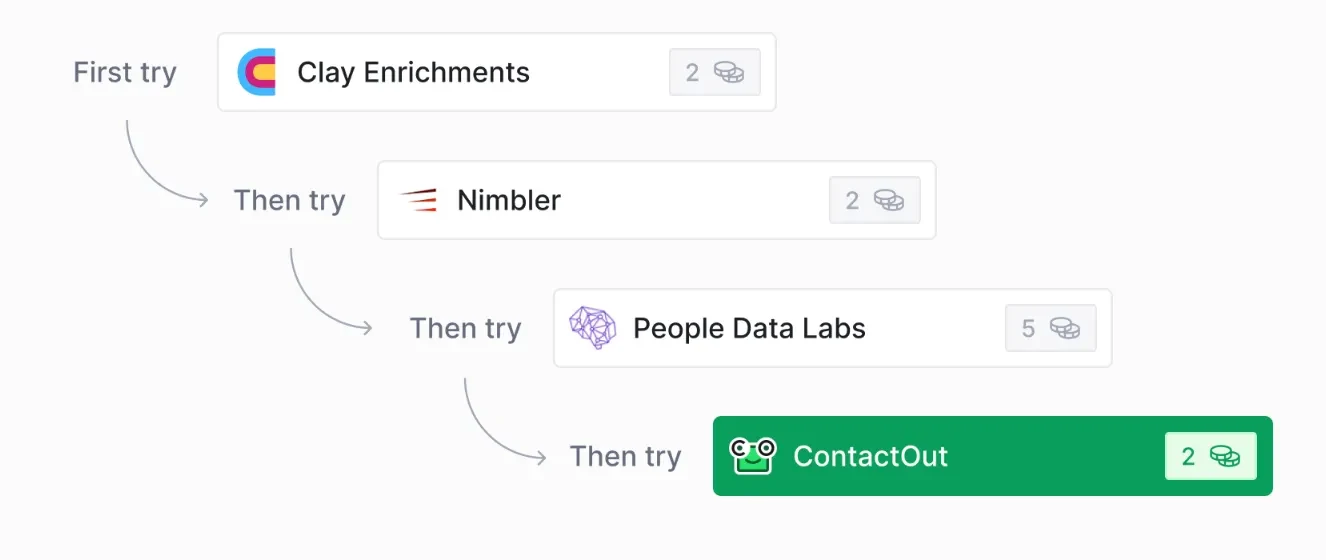
Clay is an orchestration and data workspace for GTM teams. It combines access to data providers with research and workflow execution. The central operating decision is how a record moves through the table or workflow: which provider runs, what happens on a miss and what is written to the destination system.
Capabilities to compare:
- Data-provider marketplace
- Enrichment workflows
- AI-assisted research
- Visual GTM workflow building
- Bring-your-own provider keys
Tradeoff: Clay actions and data credits are separate cost drivers. Bringing a provider key can move the data charge to that supplier while retaining Clay action consumption. A full record can invoke multiple steps, so calculate costs from the actual workflow.
In an evaluation: Build a small enrichment flow with a known input list, an acceptance rule and a fallback provider. Record the action count, data credits and external charges, then test a timeout and a replay before increasing volume.
We priced Clay for our own enrichment and signal feed in July 2026 and didn't trial it. Two rules in Clay's docs matter most against a managed waterfall like BetterContact: an empty result costs 0 actions and 0 data credits, and a step on your own provider key costs 1 action and no credits. BetterContact also says it charges only when it returns valid data, so a miss costs nothing on either, and the gap shows up in the plan fee. For us that fee was Growth, $495 a month billed monthly in November 2026, because the webhook and CRM features we needed weren't on Launch.
The pricing record separates billing periods, allowances and source dates. Use that configuration in the cost comparison rather than combining a monthly seat price with a different product’s annual rate.
BetterContact: where it fits
BetterContactPublished capabilities- Starter is mostly an email plan. The plan comparison leaves phone verification and catch-all verification off Starter, even though the plan is pitched at reps "starting on the phone."
- Catch-all handling differs by plan. Starter says catch-alls aren't charged, while catch-all *verification* is Pro and up. Ask what a Starter user gets back for a catch-all domain.
- Plan limits overlap. Pro tiers go up to 50,000 credits, but Enterprise is described as starting above 20,000. Pin down which plan your volume falls into before you sign.
Can you export the result status and charges for every row?
Check product scope ↗BetterContact is a waterfall enrichment service for B2B emails and mobile phone numbers. You give it a contact or a list. It queries 20+ data providers one after another, validates whatever comes back, and charges credits only when it returns valid data . If no email or number is found, you aren't charged. Its main pitch is mobile number discovery, and the paid tiers add a phone-scoring layer for teams that live on the dialer.
The pricing page names RocketReach, Apollo, ContactOut, Datagma, People Data Labs, Enrich.so, Prospeo and Hunter among the providers, plus about a dozen it doesn't name.
BetterContact doesn't run providers in a fixed order. A routing model it calls BetterAI picks the sequence for each contact, using geography, industry and seniority. The vendor says the model draws on 545M+ data points, and the homepage credits Claude and OpenAI models and the Landbase Applied AI Lab. You can't see from the site how the order is chosen or change it. On Enterprise you can plug in your own provider API keys and use credits you already pay for. That suits teams locked into an existing data contract.
Mobile numbers go through carrier, HLR and live-ping checks. Emails get syntax, MX, SMTP and catch-all checks, and the pricing page says email verification runs through Bouncer. Phone verification uses Trestle, IPQS and BetterContact's own checks. If a result fails, the waterfall moves on to the next provider. The vendor says 36.3% of the data it receives from providers fails its checks. The site calls the validator 4-layer in one place and 5-layer in another, so ask which checks run on your plan.
Questions buyers ask
A useful evaluation
Compare the cost of accepted incremental results, including the platform and underlying providers.
Use the same inputs and record the purchased edition, charges, output statuses and manual work. Save the export and a failed-run example so the future owner can inspect the result.