Clay is the default for enrichment and research tables, Databar is a lighter multi-provider alternative, Apify and PhantomBuster collect web and platform data, and Cargo or n8n run the jobs on a schedule. We priced Clay for a weekly signal feed at roughly $500 to $700 a month and built the account list and hiring signals ourselves from search results and public job boards instead.
Your shortlist
Editorial selectionThese products cover different parts of this job. Use the fit and buying model to decide which belong in your evaluation; display order is not a performance ranking.

GTM engineers combining data providers, research and enrichment in one workflow.
Launch (headline, entry tier): $185/month · monthly billing
Vendor source ↗Pricing read 2026-11-09 · USDTrack past champions as they change jobs, and pull lookalike companies you will grade yourself.
Growth: from $250/month · confirm commitment
Vendor source ↗Pricing read 2026-11-12 · Currency not specifiedTeams evaluating a workspace, API and MCP access to multiple data providers.
Read profile →Apify is a platform and marketplace for programs called Actors that collect web data and automate tasks. Its site includes website crawlers and platform-specific tools. For GTM work, it is a data-collection component that needs a defined source, schema, refresh cadence and destination.
Read profile →Collect and refresh prospecting inputs with scheduled automation, then hand approved outputs to the rest of the stack.
Start: $56/month · annual commitment
Vendor source ↗Pricing read 2026-11-12 · Currency not specifiedGTM engineers who want to keep TypeScript workflows in a repository while a service runs them.
Read profile →
Engineers who want a visual workflow with code steps and a self-hosting option.
Read profile →Build people, company and enrichment queries into a pipeline whose usage can be reconciled by returned record.
Read profile →Query people, companies and changing signals through an API, choosing indexed or real-time access for the job.
Custom pricing; quote on request
Vendor source ↗Pricing read 2026-11-12 · Currency not specifiedMaintain GTM context, messaging and agent workflows alongside the existing CRM and engagement stack.
Custom pricing; quote on request
Vendor source ↗Pricing read 2026-11-12 · Currency not specifiedGTM data automation covers three jobs: collecting raw data (company lists, job posts, web pages), enriching it with contacts and firmographics, and running the steps on a schedule so the output lands in a CRM or sequence. Some tools do all three; most teams end up with one tool per job. In 2026 we priced Clay, built an account list from search results, pulled hiring signals from job posts and used Ocean.io for lookalikes, and the notes below come from that work.
Build it in Clay or build it yourself?
Clay is quickest when the job is "take this list, run these providers, write the result somewhere". It gets expensive when the job runs often across many records. We priced a weekly feed in July 2026: job-change tracking on a few thousand people, news on the tenth or so of our target accounts that would have news in a given week, and a few hundred emails a month. It came to over 30,000 actions and nearly 10,000 credits a month, and we put the realistic cost at $500 to $700 a month. The same feed run monthly was about $350; daily was over $2,665. We didn't trial Clay, so those figures are list-price arithmetic. The Clay pricing page has the plan details.
Signals Clay doesn't carry are the other reason to build. We wanted to know when a target account posted a job that named a competitor, which no provider we priced offered, so we wrote it ourselves.
Building an account list from search results
A search API is a cheap way to find companies that databases miss. We ran about 9,000 Serper queries for one niche in September 2026, crawled the sites that came back and had a model judge each one against a written fit rule. That produced nearly 5,000 qualified accounts, nearly nine in ten of them not in our CRM, for about $9 of search and $60 to $90 of model calls: 1.4 to 2.1 cents per qualified account before our own time.
Two things decided the result. Query wording mattered most: hit rates ran from 95% down to 6% depending on how a query was phrased. And the judging rule needed testing against known fits; our first rubric rejected 23 of 23 companies we knew were good, and the rewrite passed 18 of 23. The Serper TAM list write-up has the full method.
Hiring signals from job posts
Job posts tell you a company is investing in the area you sell into. We tried a paid feed and public job boards from July to November 2026. Public Workday job boards were free and answered for 90 tenants, giving 17,500 postings that came down to 521 relevant roles at 65 companies. Most of the work was cleanup: 42% of one feed's rows were already closed, so filter to open posts from the last 21 days and dedupe on title and location. Keyword matching on competitor names produced mostly noise (generic terms and boilerplate), about one useful signal a week. The hiring signals write-up covers the sources and costs.
Monitoring is the part that breaks
Our failures were in the scheduling, not the data tools. A paid API returned a 402 for an empty balance and our script treated it as "no results", so all but two of about 100 seed companies came back empty before anyone noticed. A laptop cron job was blocked by the operating system and logged "Operation not permitted" for weeks. A hard-coded lookup of job-board tenants silently dropped 56 of 65 of them. Whatever runs your jobs, check the output count against the last run, treat any non-200 response as a failure and alert when a job goes quiet. We moved our jobs to a small server with GitHub Actions as a fallback.
Clay
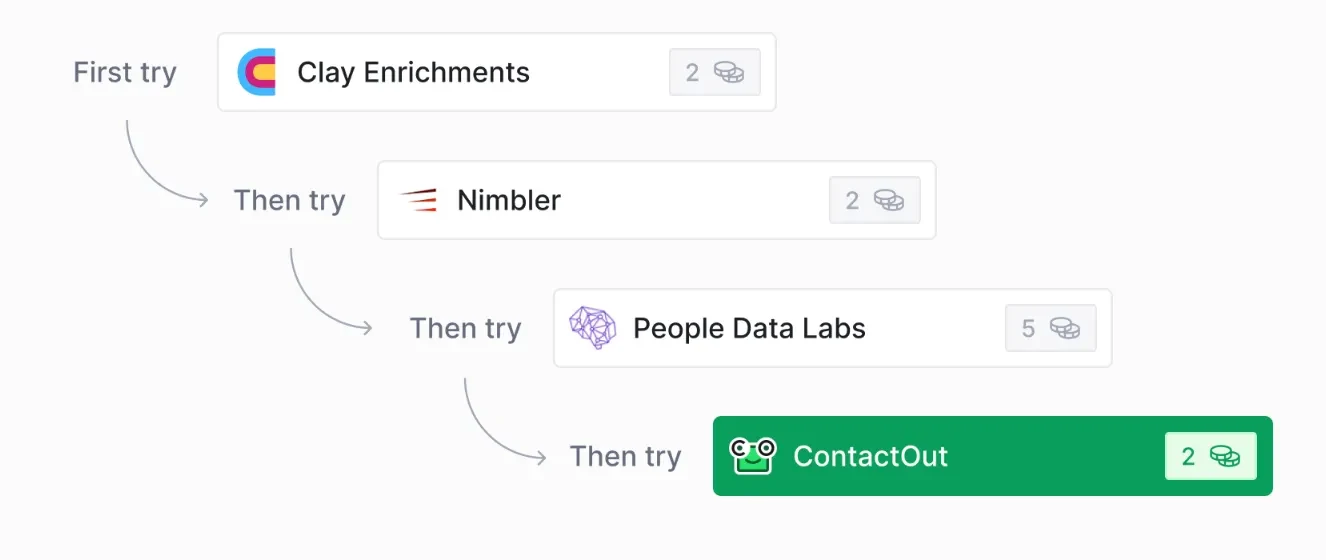
Clay is a data workspace that runs enrichment providers, AI research and workflows row by row in a table. It fits teams that want many providers behind one interface and are happy to pay per action. On the plans we saw (re-checked November 2026), Launch was $185 a month or $167 on annual billing with 15,000 actions and 2,500 data credits, and Growth was $495 or $446 with 40,000 actions and 6,000 credits. Webhooks, the HTTP API and CRM integrations sit on Growth; reading tables through the API is Enterprise-only. Bringing your own provider key costs one action and no data credits. We priced Clay and didn't trial it.
Databar
 DatabarPublished capabilities
- People and company discovery
- Multi-provider enrichment
- Research workflows
Which providers and output fields consume each type of credit?
Check product scope ↗Databar combines a data workspace with API and MCP access to many providers, for finding, enriching and monitoring people and companies. It fits teams that want Clay-style provider access with a lighter interface or an API-first setup. Check which providers back each field and whether a miss consumes credits.
Apify
 ApifyPublished capabilities
- Actor marketplace
- Website crawling
- Scheduled data collection
Which features and usage are included in your exact plan?
Check product scope ↗Apify is a marketplace of scrapers, called Actors, plus the platform to run and schedule them. It fits collecting data no database sells, such as directory listings, reviews or platform profiles. Actors vary in quality, maintenance and pricing, so run one small job and read the output before scheduling. Check the source site's terms for your intended use.
PhantomBuster
- Public-platform data extraction and lead-list workflows
- Enrichment and email finding
- LinkedIn outreach workflows
Will the purchased slots and execution hours cover the scheduled jobs, including retries and refreshes?
Check product scope ↗PhantomBuster runs ready-made automations for LinkedIn and other platforms, such as extracting search results or profile data, on a schedule. It fits small teams that want platform data without writing scrapers. Platform limits and account risk come with LinkedIn automation, so keep volumes low and check the platform's rules.
Cargo
 CargoPublished capabilities
- Repository-owned TypeScript workflows
- Production execution
- Retries
Which runtime limits, retries and provider costs are included?
Check product scope ↗Cargo runs GTM workflows written in TypeScript and kept in a repository, with retries, rate-limit handling and run logs handled for you. It fits teams that already write code and want version control on their enrichment and routing logic. You still own the business logic and the connected accounts' permissions.
n8n
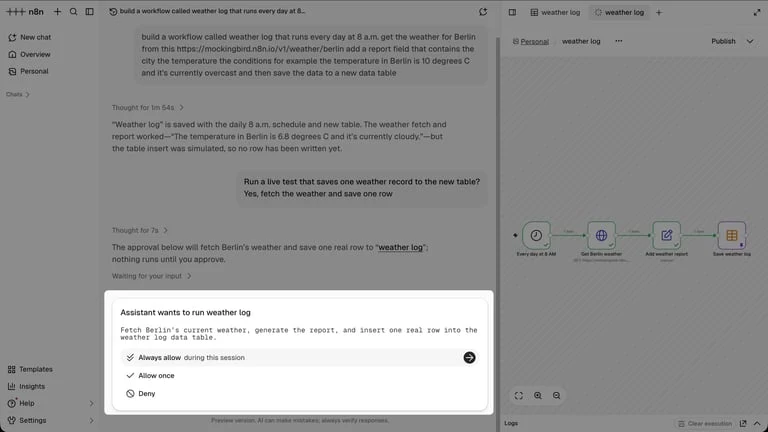
n8n is a visual workflow tool with code steps, hosted or self-hosted. It fits teams that want a scheduler and integrations without writing every job from scratch, at a lower cost than per-action pricing. In November 2026 the annual-billed Starter plan was €20 a month and Pro €50. We ran our own jobs as scripts, not in n8n; the n8n cloud vs self-hosted write-up covers what self-hosting would take. See n8n pricing.
Ocean.io
- Moves appeared one to three months after they happened.
- Some "movers" had only changed title inside the same company.
- A company that changes its domain looks the same as a person leaving it. We treated a move to a domain sharing the old name as a rebrand.
How many of 60 lookalikes pass your written fit rule, and how many already built what you sell?
Check product scope ↗Ocean.io finds lookalike companies from seed accounts you provide. In August 2026, 11 of 59 lookalikes passed our written fit rule, in a narrow niche that is a hard case for any lookalike tool. Its relevance grades were generous, and a country filter written as "United States" returned nothing without an error, while "us" worked. Use it to widen a list, and judge each result against your own rule. The Ocean.io review has more.
Before you schedule any job
- Run it on a small, known input and read every output row.
- Record the source and date on each field you write.
- Decide whether a re-run appends, replaces or updates, and use stable keys.
- Treat errors and empty pages as failures, with an alert.
- Compare the cost per usable record, not per attempt.
Questions buyers ask
What are the best GTM data automation tools?
Clay or Databar for enrichment tables, Apify or PhantomBuster for collecting web and platform data, and Cargo, n8n or your own scripts to run jobs on a schedule.
How much does Clay cost for a recurring signal feed?
We priced a weekly job-change, news and email feed at over 30,000 actions and nearly 10,000 credits a month, roughly $500 to $700 a month on the plans we saw in July 2026. Monthly was about $350 and daily over $2,665.
Is Clay worth it or should I build it myself?
Clay is quickest for one-off and low-frequency enrichment. Frequent jobs over many records, or signals Clay doesn't carry, are where building your own starts to pay.
How do you build a target account list without a database?
Run search API queries for your niche, crawl the results and have a model judge each site against a tested fit rule. Our Serper run found over 4,000 qualified accounts not in our CRM, at 1.4 to 2.1 cents per qualified account.
Why do automated GTM jobs fail silently?
Errors get read as empty results and schedulers stop without alerting. Ours treated a payment error as no data and lost all but two of about 100 lookups; check output counts and alert on non-200 responses.