FullEnrich and BetterContact belong on an enrichment-waterfall shortlist. n8n is a workflow engine that requires you to assemble and operate the data-provider steps. Cargo and Databar are relevant to other data-operation requirements.
Replacement scope
FullEnrich and BetterContact belong on an enrichment-waterfall shortlist. n8n is a workflow engine that requires you to assemble and operate the data-provider steps. Cargo and Databar are relevant to other data-operation requirements. Choose around the Clay workflow you actually need to move.
| Product | Working scope | Pricing record |
|---|---|---|
| Clay | Enrichment orchestration | Plans |
| FullEnrich | Waterfall enrichment | Plans |
| BetterContact | Waterfall enrichment | Vendor offer |
| n8n | Workflow automation | Plans |
| Cargo | Code-based GTM workflows | Vendor offer |
| Databar | Data workspace and API | Vendor offer |
Why we priced Clay and built instead
We priced Clay in July 2026 for a weekly feed of job changes on 8,000 people and about 400 news results a month, and didn't trial it. The webhook and CRM integrations the feed needed were on Growth, and our workload came to about $610 a month at Clay's unit costs. We built the feed on APIs we already paid for, mostly because our best signal was a competitor's product name inside job-post text, and Clay's job search sat outside its public API at the time.
The build was far cheaper in vendor fees, specced at $61 once plus about $36 a month, and it broke in ways Clay's price would have covered. One job-board poller dropped 56 of 65 boards with no error, a provider's payment errors read as "no news" on 103 of 105 accounts, and the weekly job wasn't running on schedule. If nobody on your team will own a scheduler, its retries and a weekly check that each job produced output, staying on Clay is the cheaper choice. The full comparison is on data enrichment.
Clay: where it fits
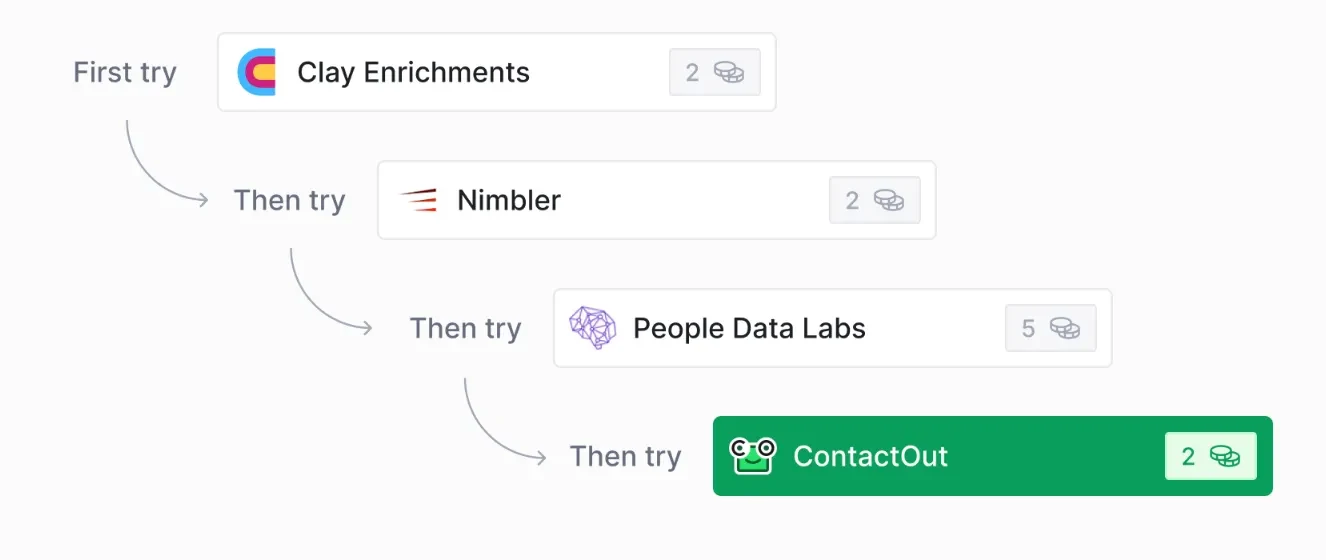
Clay is an orchestration and data workspace for GTM teams. It combines access to data providers with research and workflow execution. The central operating decision is how a record moves through the table or workflow: which provider runs, what happens on a miss and what is written to the destination system.
Capabilities to compare:
- Data-provider marketplace
- Enrichment workflows
- AI-assisted research
- Visual GTM workflow building
- Bring-your-own provider keys
Tradeoff: Clay actions and data credits are separate cost drivers. Bringing a provider key can move the data charge to that supplier while retaining Clay action consumption. A full record can invoke multiple steps, so calculate costs from the actual workflow.
In an evaluation: Build a small enrichment flow with a known input list, an acceptance rule and a fallback provider. Record the action count, data credits and external charges, then test a timeout and a replay before increasing volume.
The pricing record separates billing periods, allowances and source dates. Use that configuration in the cost comparison rather than combining a monthly seat price with a different product’s annual rate.
FullEnrich: where it fits
Measure the additional accepted records from the waterfall.
FullEnrich sits between your prospect list and a group of contact-data vendors. You give it a name and company, a list from its search, a HubSpot list, or a CSV or Excel file. It then queries providers one after another until it finds an email or phone number. The homepage says it pulls from 20+ premium vendors . The plan comparison table on the pricing page says 25+ sources. The provider logos it shows include Clearbit, Wiza, ContactOut, Anymail Finder, Snov and Hunter. FullEnrich says it picks vendors based on where each lead is located.
The bigger difference is the filtering after the lookup. FullEnrich claims that 31.53% of the data it buys fails its verification, and that you neither receive nor pay for that data. Emails go through three verification engines, and one disagreement drops the address. FullEnrich says it resolves catch-all domains instead of flagging them as risky, and its pricing table claims 80% of catch-alls get verified. Each email it delivers carries a bounce probability. Phone numbers are checked against the carrier network, and dead lines are removed. Landlines are returned free. The check that the line belongs to the named person applies only in the US and Canada.
The pricing page lists a HubSpot integration that can push contacts and companies and enrich records already in HubSpot. A version that runs inside HubSpot is marked "Soon". The page also mentions CRM integrations and no-code integration in general terms, but HubSpot is the only CRM named in the sources. The MCP server, all three APIs and bulk CSV enrichment come with Pro. Custom rate limits and concurrency are Enterprise-only, and no default API limits are published. If you plan to call the API heavily, ask for those limits before you sign.
The pricing record separates billing periods, allowances and source dates. Use that configuration in the cost comparison rather than combining a monthly seat price with a different product’s annual rate.
BetterContact: where it fits
 BetterContactPublished capabilities
- Starter is mostly an email plan. The plan comparison leaves phone verification and catch-all verification off Starter, even though the plan is pitched at reps "starting on the phone."
- Catch-all handling differs by plan. Starter says catch-alls aren't charged, while catch-all *verification* is Pro and up. Ask what a Starter user gets back for a catch-all domain.
- Plan limits overlap. Pro tiers go up to 50,000 credits, but Enterprise is described as starting above 20,000. Pin down which plan your volume falls into before you sign.
Can you export the result status and charges for every row?
Check product scope ↗BetterContact is a waterfall enrichment service for B2B emails and mobile phone numbers. You give it a contact or a list. It queries 20+ data providers one after another, validates whatever comes back, and charges credits only when it returns valid data . If no email or number is found, you aren't charged. Its main pitch is mobile number discovery, and the paid tiers add a phone-scoring layer for teams that live on the dialer.
The pricing page names RocketReach, Apollo, ContactOut, Datagma, People Data Labs, Enrich.so, Prospeo and Hunter among the providers, plus about a dozen it doesn't name.
BetterContact doesn't run providers in a fixed order. A routing model it calls BetterAI picks the sequence for each contact, using geography, industry and seniority. The vendor says the model draws on 545M+ data points, and the homepage credits Claude and OpenAI models and the Landbase Applied AI Lab. You can't see from the site how the order is chosen or change it. On Enterprise you can plug in your own provider API keys and use credits you already pay for. That suits teams locked into an existing data contract.
Mobile numbers go through carrier, HLR and live-ping checks. Emails get syntax, MX, SMTP and catch-all checks, and the pricing page says email verification runs through Bouncer. Phone verification uses Trestle, IPQS and BetterContact's own checks. If a result fails, the waterfall moves on to the next provider. The vendor says 36.3% of the data it receives from providers fails its checks. The site calls the validator 4-layer in one place and 5-layer in another, so ask which checks run on your plan.
n8n: where it fits
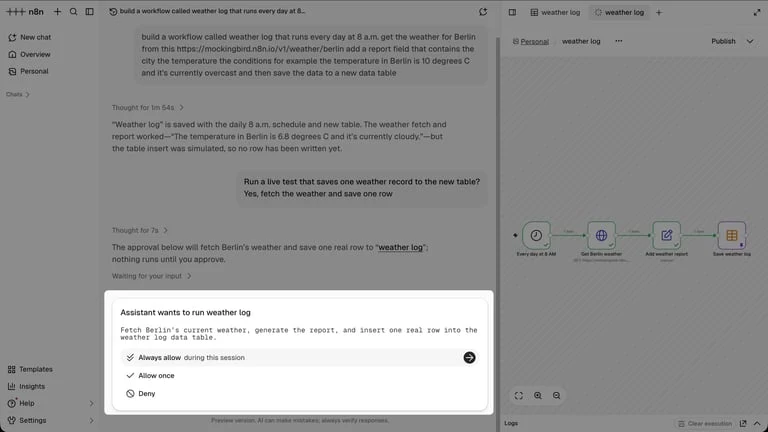
n8n is a workflow platform that combines a visual execution graph with code-capable steps. It can be used as a hosted service or operated on your own infrastructure. GTM use cases include incoming lead validation, enrichment, routing and CRM updates, with the workflow owner responsible for the behavior between connected systems.
Capabilities to compare:
- Visual workflow editor
- Code steps
- API and application connections
- AI-agent workflows
- Cloud and self-hosted editions
Tradeoff: Cloud execution billing and self-hosted operating cost require different budgets. The Community edition does not include every paid-edition feature, and self-hosting still requires backups, upgrades and monitoring. Check the license and edition for the intended use.
In an evaluation: Build a lead-intake flow with validation, a durable deduplication check and a CRM write. Deliberately fail the external API step, inspect the run and recover it without creating a duplicate record or paying twice for a completed lookup.
The pricing record separates billing periods, allowances and source dates. Use that configuration in the cost comparison rather than combining a monthly seat price with a different product’s annual rate.
Cargo: where it fits
 CargoPublished capabilities
- Repository-owned TypeScript workflows
- Production execution
- Retries
Which runtime limits, retries and provider costs are included?
Check product scope ↗Cargo is infrastructure for GTM workflows written in TypeScript and maintained in a repository. Its current positioning emphasizes work created through a coding agent while Cargo handles production execution. It is a different operating model from a spreadsheet workspace or a purely visual no-code scenario.
Capabilities to compare:
- Repository-owned TypeScript workflows
- Production execution
- Retries
- Rate-limit handling
- Run logs
Tradeoff: Your team still owns the business logic and the permissions of connected services. Confirm runtime limits, secret management and provider billing. A managed runtime reduces some operational work but does not remove the need to inspect code and outputs.
In an evaluation: Take one existing enrichment or CRM operation, put the logic under version control and run it against test records. Inspect a rate-limit response and a retry, compare logs with external usage and roll back a small change.
Databar: where it fits
 DatabarPublished capabilities
- People and company discovery
- Multi-provider enrichment
- Research workflows
Which providers and output fields consume each type of credit?
Check product scope ↗Databar combines a data workspace with API and MCP access to multiple providers. Its website describes finding, enriching, researching and monitoring people and companies. The evaluation should distinguish record discovery from enrichment and recurring monitoring, because each can have different data requirements and charges.
Capabilities to compare:
- People and company discovery
- Multi-provider enrichment
- Research workflows
- Monitoring and buying signals
- Workspace, API and MCP access
Tradeoff: A single interface does not make outputs from different providers equivalent. Preserve the provider and source date with returned fields, and confirm which result or attempt consumes credits. Monitoring also requires a reasonable refresh cadence.
In an evaluation: Use a fixed account sample, inspect the providers and fields returned and reconcile the charge for unresolved records. Test a repeated query and a changed record, then verify how the chosen destination receives the update.
Run the same workload
Write down the input, required output and acceptance rule before opening either product. Use the same records, audience, channels and destination. If the products cover different parts of the process, include the missing component in the evaluation rather than assuming that one product replaces the entire stack.
Follow the output all the way to the person using it. A data response is useful when it passes the acceptance rule and reaches the right record; a booked meeting is useful when ownership and qualification are correct. Keep operational failures separate from a failure to match or produce a result.
What the cost comparison should include
- The configuration and billing period required for the actual users.
- Data and usage charged by both the platform and connected providers.
- Communications, mailboxes or infrastructure purchased elsewhere.
- Implementation, migration and ongoing administration.
- Export rights, renewal terms and the cost of switching again.
Plan the handoff or migration
Export a representative sample before committing to a switch. Map stable identifiers and field ownership, preserve the source and date of enriched data and check which configuration can be reproduced. Run a bounded parallel test before decommissioning a working integration. Confirm that an account owner can inspect failures and recover a record without repeating a paid operation or creating duplicates.
Questions buyers ask
Which option should we choose?
FullEnrich and BetterContact belong on an enrichment-waterfall shortlist. n8n is a workflow engine that requires you to assemble and operate the data-provider steps. Cargo and Databar are relevant to other data-operation requirements. Choose around the Clay workflow you actually need to move.
Is it cheaper to build your own Clay workflow?
In vendor fees it was for us: about $61 once plus $36 a month, against about $610 a month for our weekly feed on Clay at July 2026 prices. That leaves out engineering time and monitoring, and our build had silent failures, including a weekly job that hadn't been running on schedule.
Can these products replace one another?
Only where their working scopes overlap. Identify the exact data, execution or operating job being moved and include any additional tool needed to complete the process.
How should we compare the price?
Use the same workload and commitment period, including required users, usage and connected services. Quoted offers and dated public rates should remain distinguishable.
What should a pilot prove?
That the intended users can complete the workflow, inspect its outputs, repair a failure and understand the resulting cost. It does not need to claim a universal product winner.